Follow the ingredients, energy, and products of a plant's sugar-making process.
Start with a topic and see how its parts connect. Explore 32 mind maps with explanations, practice questions, and printable PDFs, then adapt a structure or build your own from scratch.
Follow the ingredients, energy, and products of a plant's sugar-making process.
Connect organisms, their environment, energy flow, and the recycling of matter.
Trace water through evaporation, clouds, rainfall, soil, and rivers.
Distinguish the particles of matter from the ways substances are combined.
Track energy into a system, through changes, and out to the surroundings.
Connect equal parts, number lines, equivalent fractions, and calculation.
Separate the percentage amount from the final price.
Build a clear claim with reasons, evidence, and a response to objections.
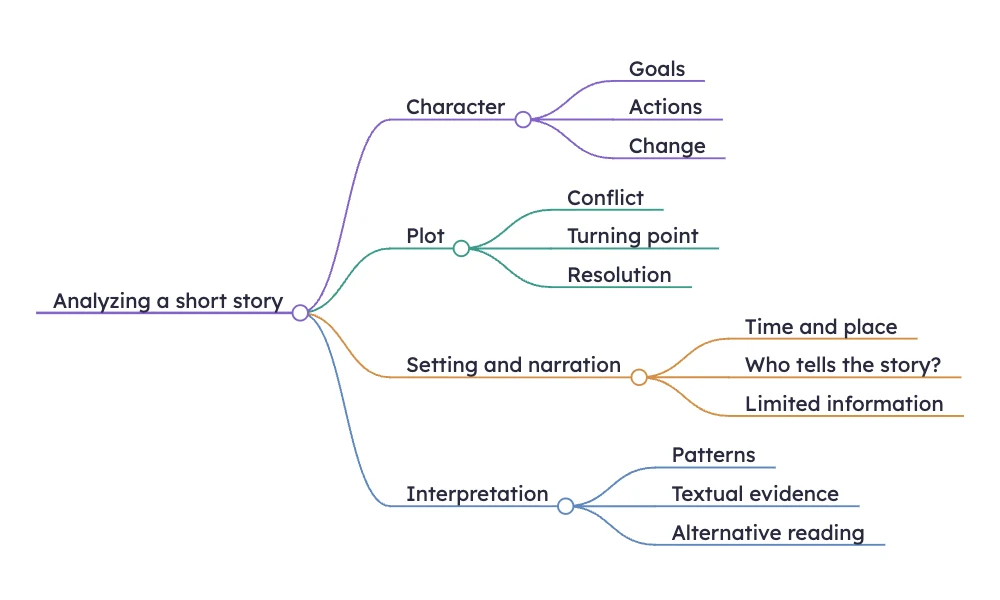
Connect character, plot, setting, and narration to an interpretation supported by the text.
Separate conditions, production changes, and uneven social consequences.
Use a clearly labeled U.S. example to distinguish participation, rights, and institutional responsibilities.
Turn a broad intention into specific practice and evidence of progress.
Link organelles to functions and compare animal and plant cells.
Connect fuel molecules, cellular locations, ATP, and the work cells perform.
Connect DNA, genes, chromosomes, alleles, and the limits of simple inheritance models.
Explain population change through inherited variation and reproductive success.
Follow food through breakdown and absorption while distinguishing supporting organs.
Distinguish current, voltage, resistance, and circuit arrangement.
Use net force to explain changes in velocity.
Distinguish planets, orbital motion, rotation, and the limitations of diagrams.
Interpret measurements and indicators without tasting or mixing chemicals.
Choose the right quantity, formula, and units for a shape.
Keep both sides equivalent and verify the solution in the original equation.
Define outcomes and assumptions before calculating a chance.
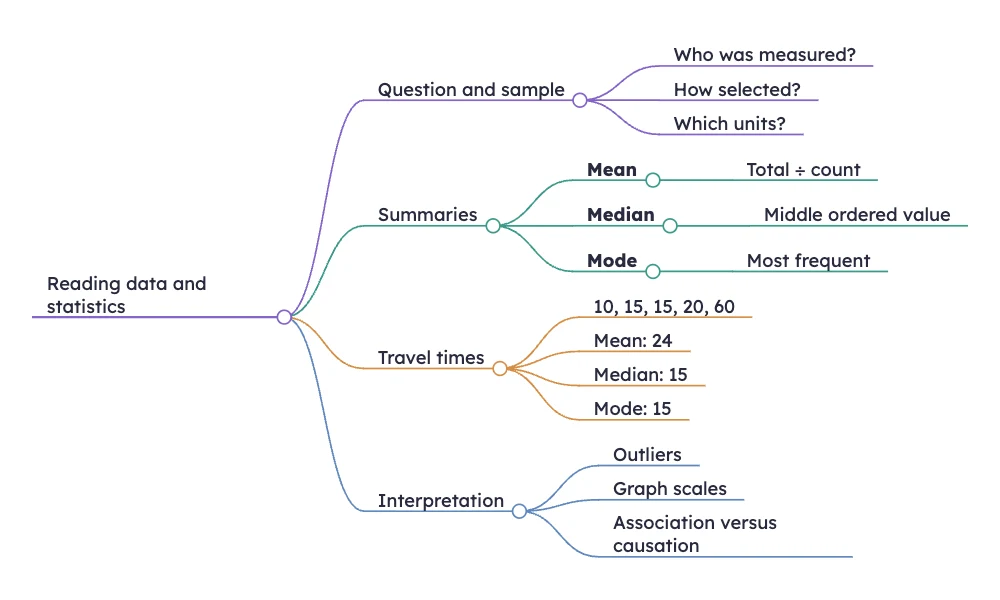
Choose summaries after understanding the question and how the data were collected.
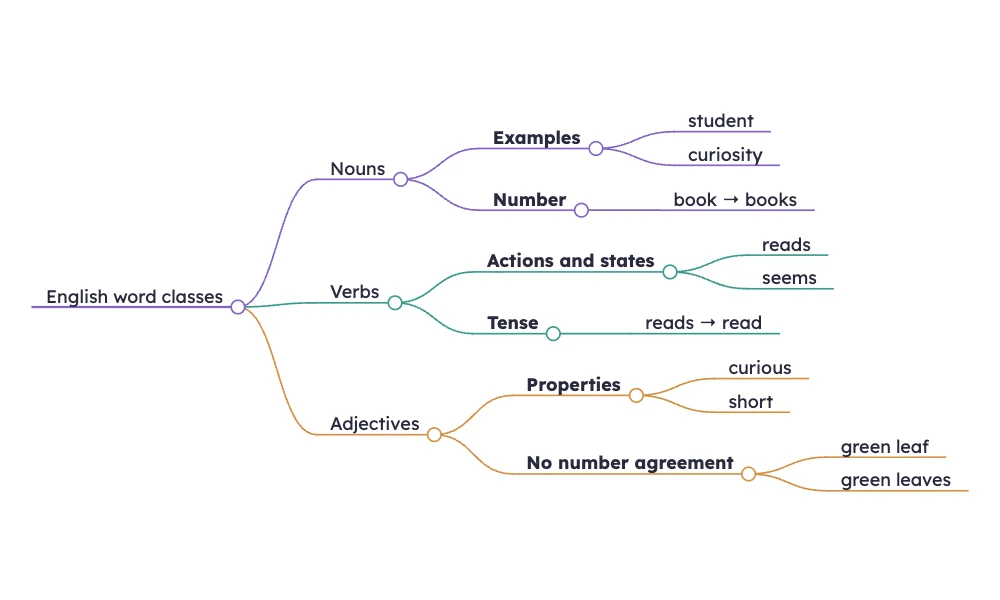
Identify nouns, verbs, and adjectives by examining them in a sentence.
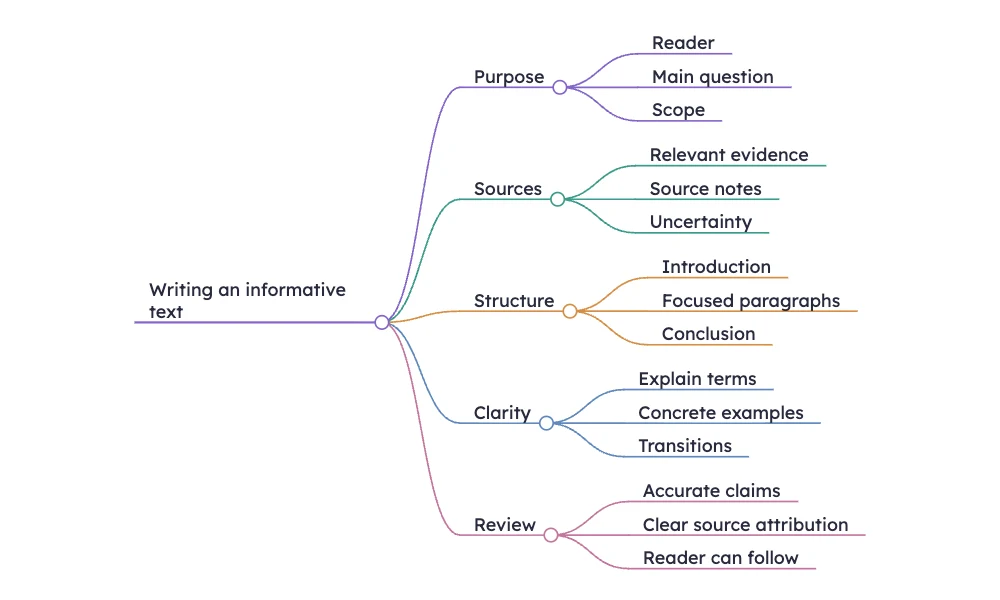
Organize accurate information around a question and useful subtopics.
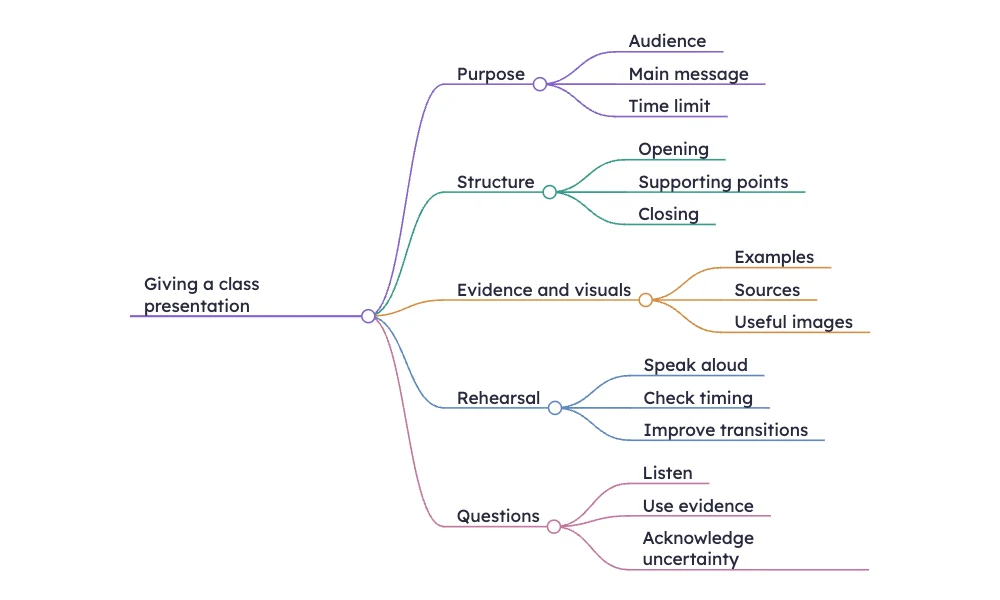
Plan a message, supporting points, visuals, and a useful rehearsal.
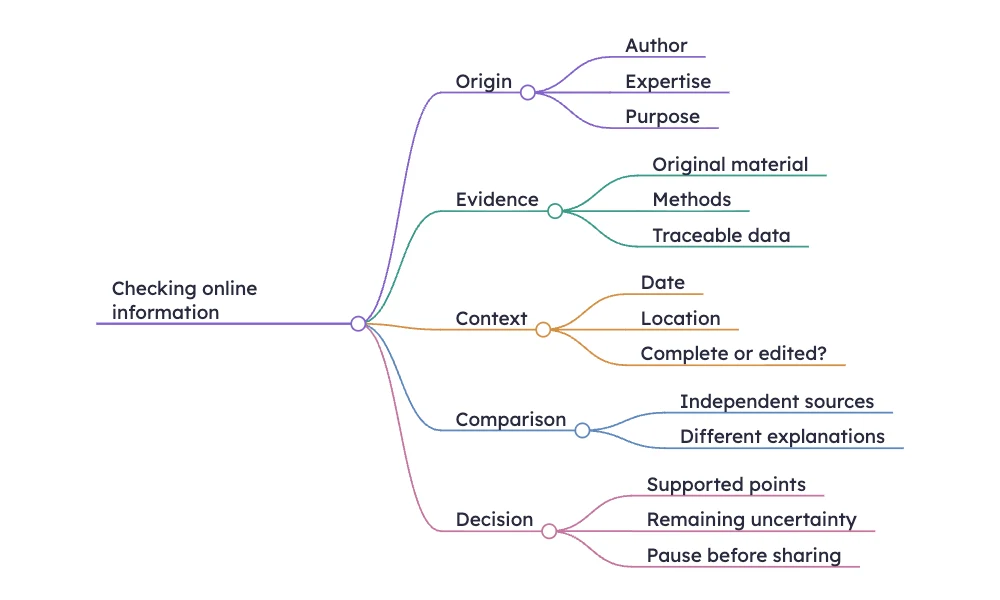
Trace a claim to its evidence, date, purpose, and original context.
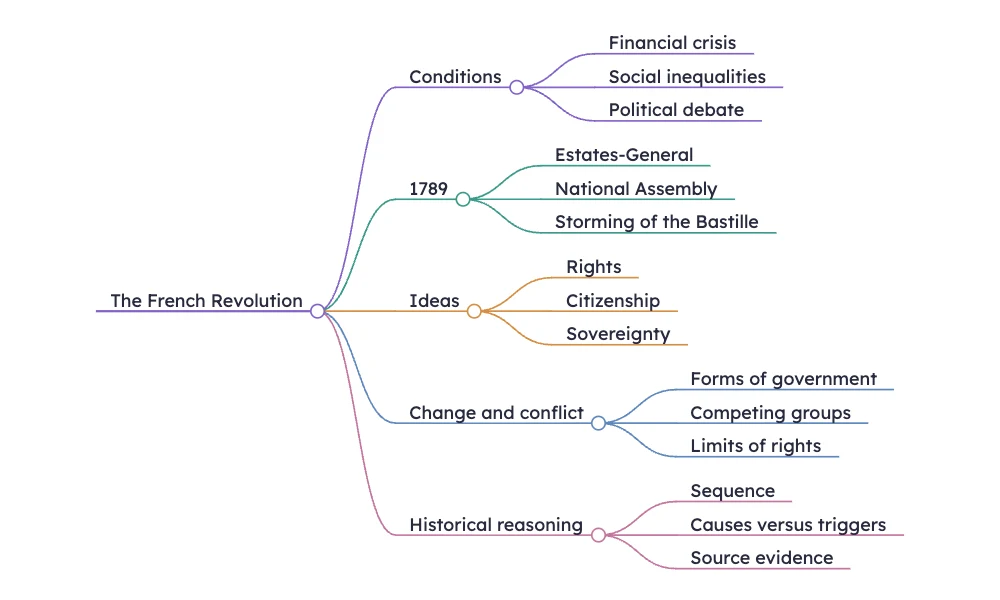
Separate long-term conditions, events, political ideas, and contested outcomes.
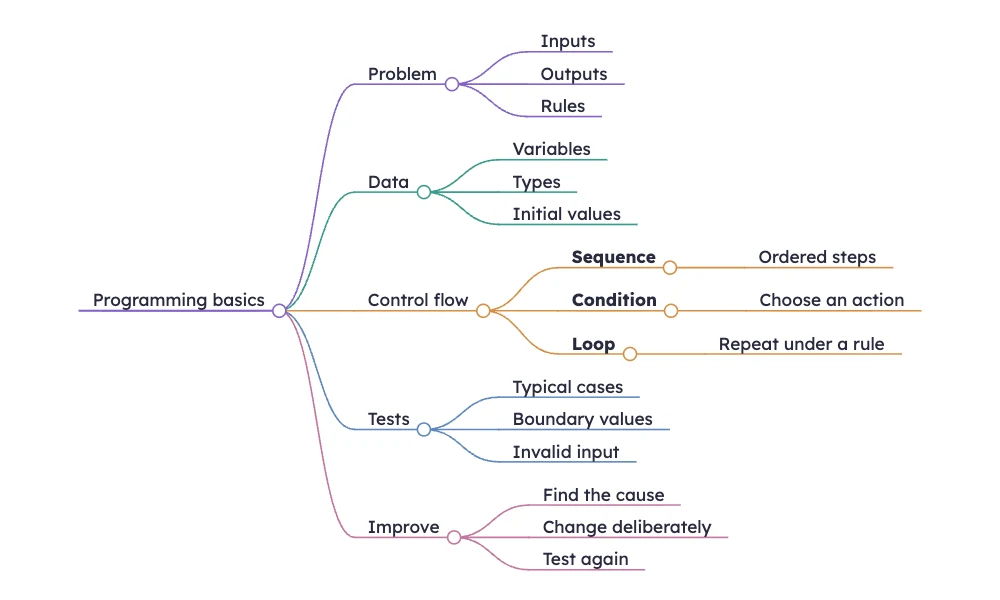
Turn a problem into data, decisions, repetition, and tests.
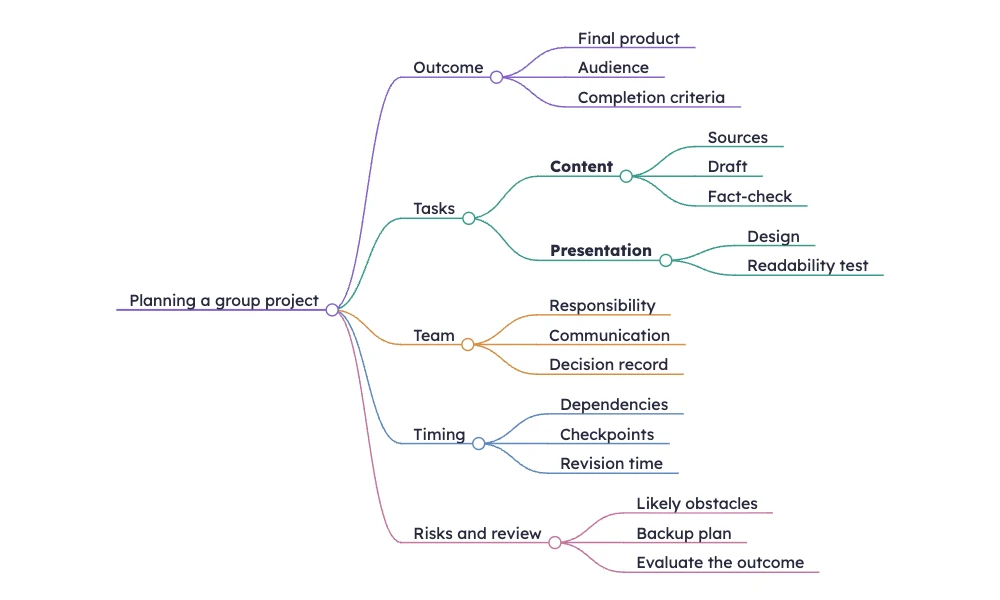
Agree on an outcome, responsibilities, checkpoints, and a way to handle setbacks.
Biology · Foundation
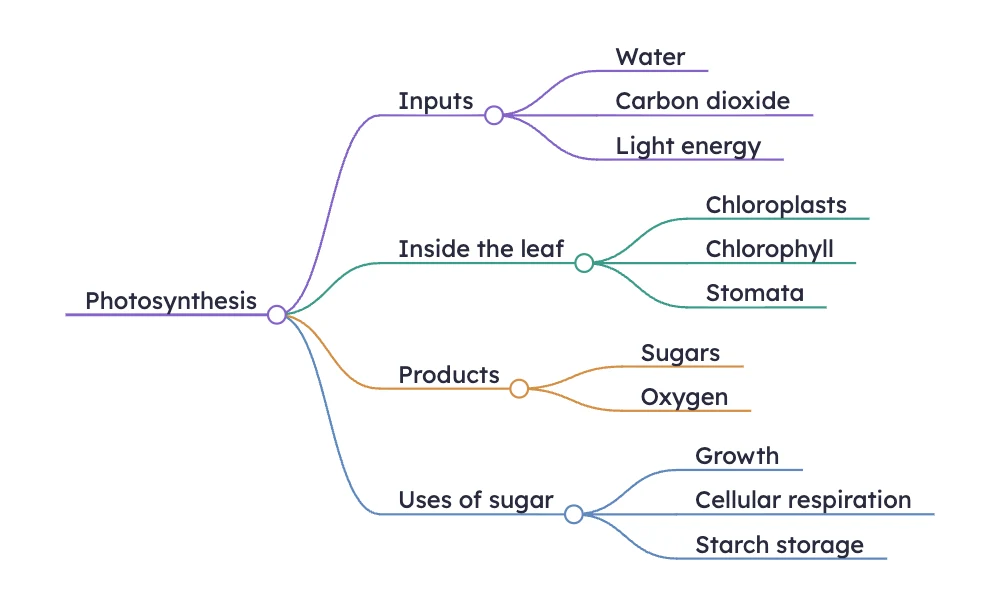
Follow the ingredients, energy, and products of a plant's sugar-making process.
Download original · PDFWorksheet & answers · PDFPlants use light energy to build sugars from carbon dioxide and water. Chlorophyll absorbs light, roots supply water, and carbon dioxide enters through stomata. Sugars provide material for growth and fuel for cellular respiration; some can be stored as starch. Oxygen is released during the process.
Separate inputs, location, products, and uses. This keeps an energy source distinct from the matter used to build sugar.
Cover the products branch and explain what happens to the sugar. Predict what changes when a plant receives less light, and identify another variable to control.
Plants also carry out cellular respiration. Photosynthesis does not replace it.
Energy
Light supplies energy; carbon dioxide supplies the carbon used to build sugars.
Yes, during the day and night
Living plant cells need usable energy for their activities.
Ecology · Foundation
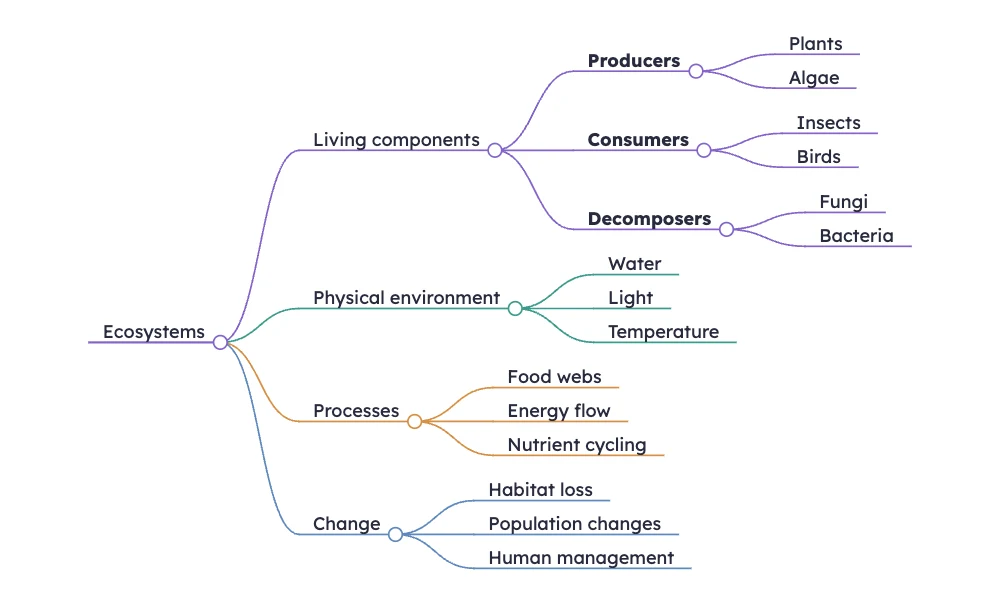
Connect organisms, their environment, energy flow, and the recycling of matter.
Download original · PDFWorksheet & answers · PDFAn ecosystem includes living organisms and their physical environment. Producers capture energy, consumers obtain energy by feeding, and decomposers break down organic material. Feeding relationships form networks. Water, light, temperature, and soil conditions influence which organisms can live in a place.
Group components separately from processes. Then use the change branch to reason about consequences rather than memorize a list.
Choose a pond or school garden. Describe two possible effects of reduced rainfall, stating which organisms and processes are involved.
Matter cycles, while energy flows and is eventually dispersed as heat. These are different patterns.
Water
Water influences organisms but is not itself an organism.
Organisms can have several feeding relationships
A web shows connected feeding relationships that one chain leaves out.
Geography · Foundation
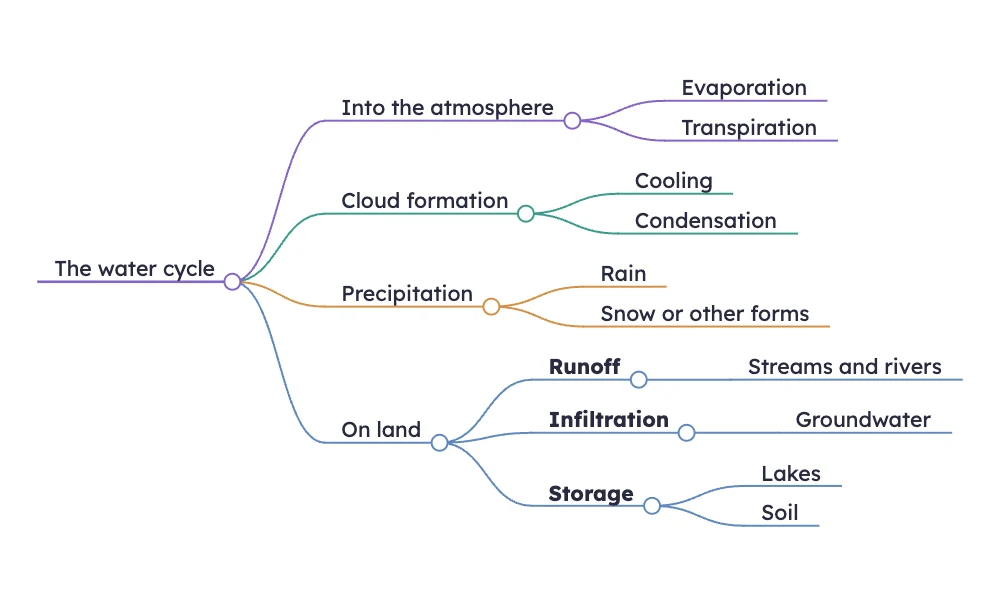
Trace water through evaporation, clouds, rainfall, soil, and rivers.
Download original · PDFWorksheet & answers · PDFSolar energy drives evaporation, and plants release water vapor through transpiration. Cooling can cause vapor to condense into droplets. Water returns as precipitation and may run off, infiltrate the ground, or remain in storage. Not every drop follows the same route or spends the same time in each reservoir.
The branches show processes and storage places. Read them as connected possibilities, not a fixed timetable.
Trace rain falling on a garden and on a paved playground. Compare infiltration and runoff, then explain where each route might lead.
Clouds contain tiny liquid droplets or ice crystals. Water vapor itself is an invisible gas.
Water entering the ground
Infiltration is the movement of water from the surface into the soil.
Surface runoff
An impermeable surface limits infiltration at that location.
Chemistry · Foundation
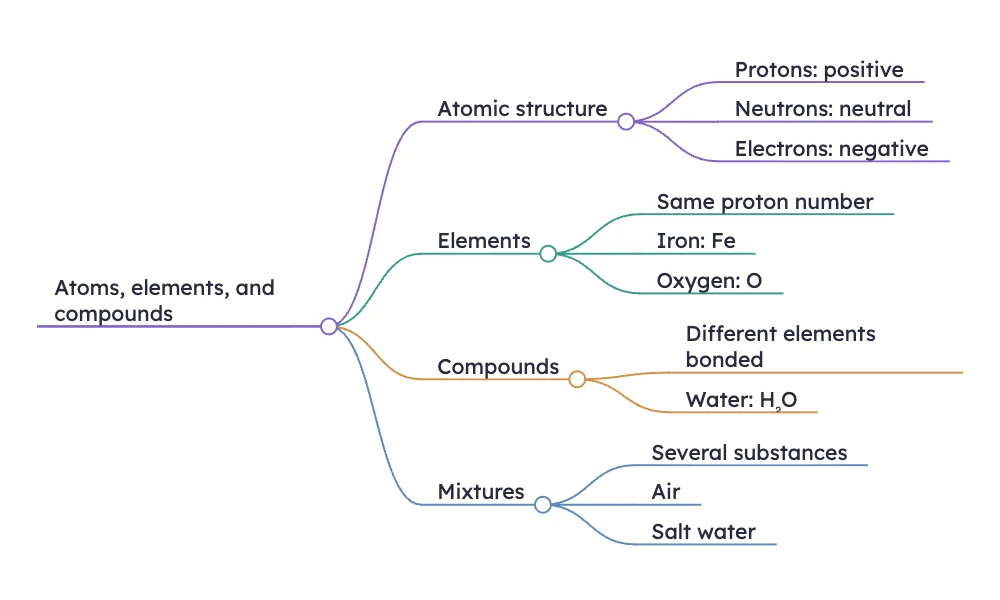
Distinguish the particles of matter from the ways substances are combined.
Download original · PDFWorksheet & answers · PDFAtoms contain protons, electrons, and usually neutrons. The number of protons identifies an element. A compound contains atoms of different elements chemically combined in fixed proportions. A mixture contains more than one substance without requiring a new compound to form.
Start with atomic structure, then compare elements, compounds, and mixtures using concrete examples.
Classify iron, pure water, air, and salt water. Explain each choice, then use O₂ to test the distinction between a molecule and a compound.
A molecule is not necessarily a compound: O₂ contains only one element.
Its proton number
Atoms of the same element have the same number of protons.
It contains several gases
Air contains substances including nitrogen and oxygen.
Physics · Foundation
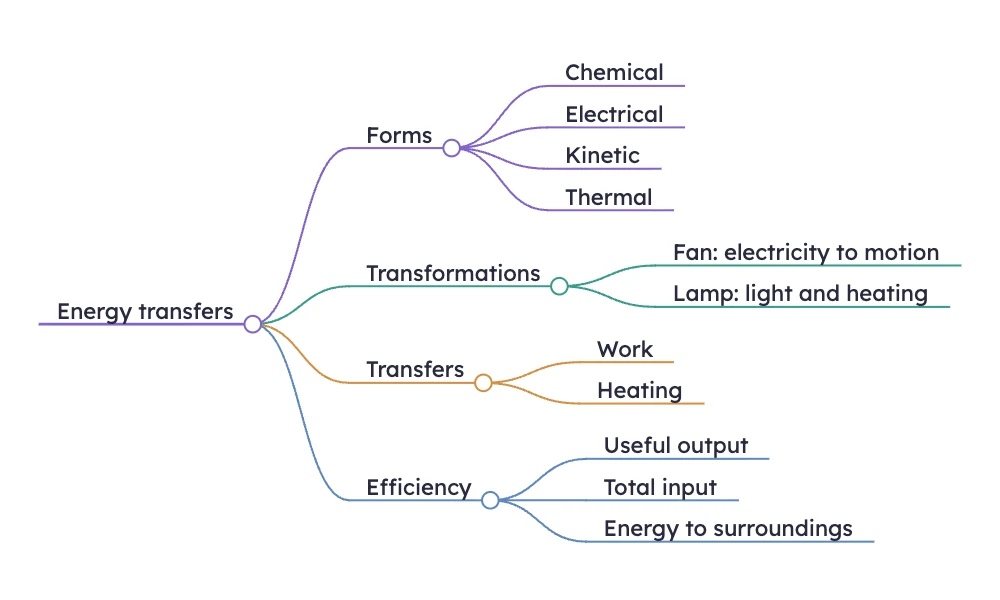
Track energy into a system, through changes, and out to the surroundings.
Download original · PDFWorksheet & answers · PDFEnergy can be transferred and transformed. An electric fan transfers electrical energy into motion, sound, and thermal energy. Total energy is conserved in an isolated system, but not all input becomes the output we want. Defining the system boundary helps identify energy entering and leaving.
Use forms to name energy, devices to illustrate transformations, and efficiency to discuss useful output.
Choose an electric kettle. Identify its input, intended output, and energy transferred to the room. Draw a system boundary and explain what crosses it.
Energy is not destroyed when a device stops. Some has become less useful by dispersing into the surroundings.
Moving air
Moving air is the intended output, although other transfers also occur.
A defined system boundary
A boundary clarifies which transfers enter or leave the system.
Mathematics · Foundation
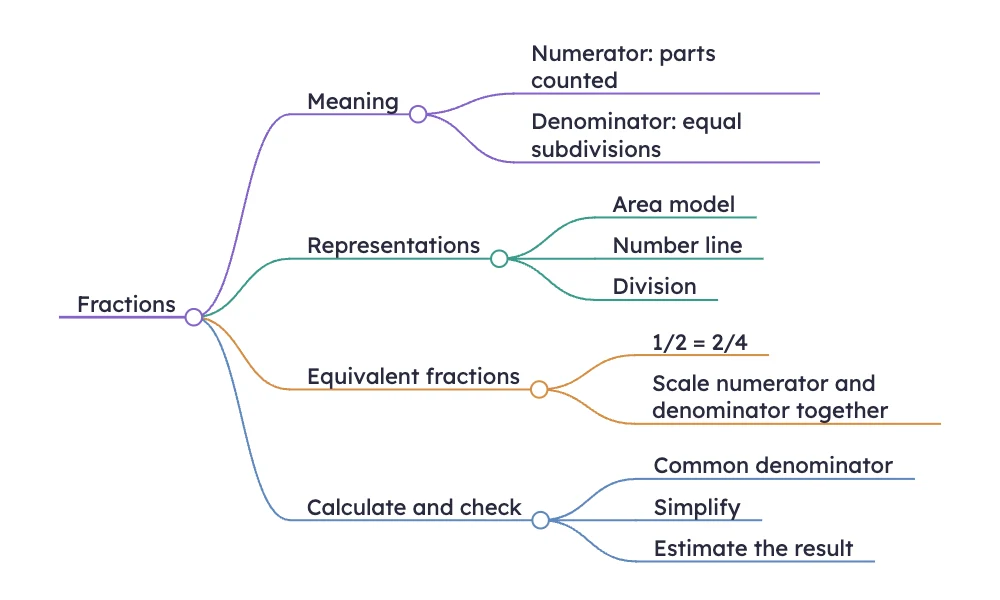
Connect equal parts, number lines, equivalent fractions, and calculation.
Download original · PDFWorksheet & answers · PDFA fraction a/b can represent a parts when a whole is divided into b equal parts, with b not zero. It can also represent division or a point on a number line. Equivalent fractions express the same value. When comparing parts of objects, check that the wholes are equal in size.
Establish meaning before operations. Use pictures and a number line to explain why equivalent fractions match.
Show 1/2 and 2/4 using equal-sized rectangles and a number line. Then explain 1/2 + 1/4 without merely reciting a rule.
Adding denominators does not add fractions correctly. Use a common denominator.
3/4
Rewrite 1/2 as 2/4, then add the numerators.
Equal in size
The denominator describes equal subdivisions of a whole.
Mathematics · Intermediate
Separate the percentage amount from the final price.
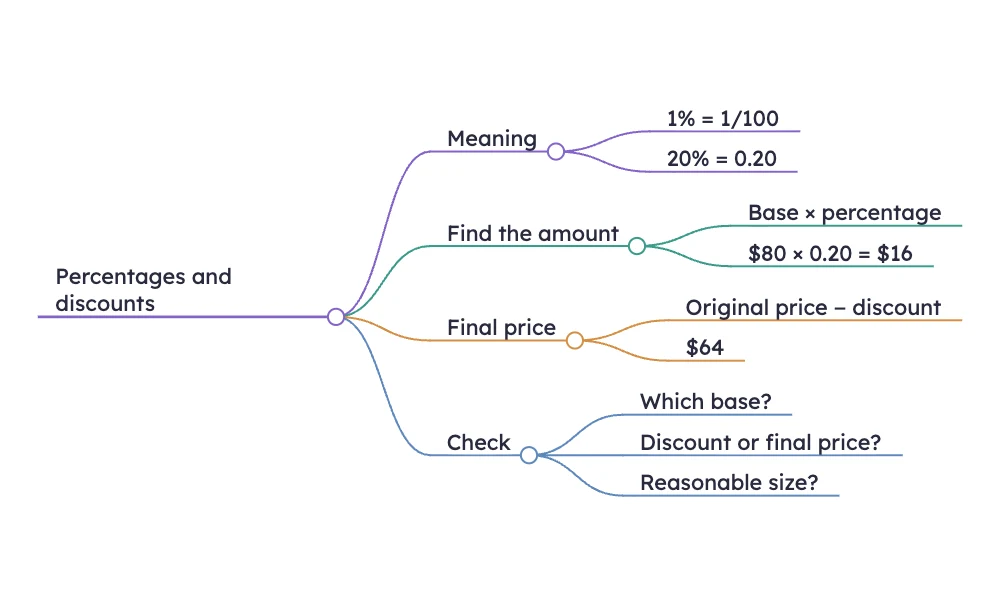
Download original · PDFWorksheet & answers · PDFPercent means per hundred. Twenty percent of $80 is 0.20 × 80 = $16. If that is a discount, the final price is $64. A percentage always refers to a base amount. Successive changes must use the correct base at each stage.
The branches distinguish meaning, the percentage amount, the final value, and checks.
Find a 25% discount on a $60 book using multiplication and division into quarters. State both the discount and the amount paid.
A 20% increase followed by a 20% decrease does not return to the starting value because the base changes.
$15
A quarter of $60 is $15.
$45
Subtract the $15 discount from $60.
English · Writing template
Build a clear claim with reasons, evidence, and a response to objections.
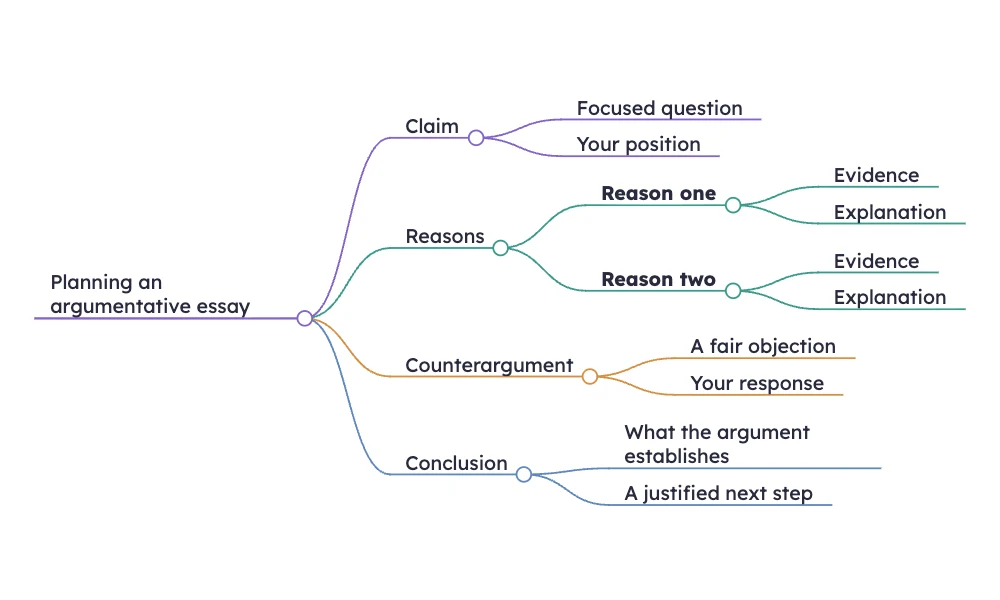
Download original · PDFWorksheet & answers · PDFAn argumentative essay presents a position and explains why a reader should accept it. Each reason needs relevant support and an explanation connecting that support to the claim. Address a reasonable objection fairly. The conclusion should follow from the argument rather than introduce a new unsupported claim.
Give each reason an evidence branch and an explanation branch. Keep the opposing view separate from your response.
Argue for a specific change to school waste collection. Add two reasons, identify suitable evidence, and respond to one practical objection.
A personal example can illustrate a point without proving that it applies to everyone.
An explanation of its relevance
Explain how the evidence supports the reason and overall claim.
With reasons and evidence
Engage with the objection itself, not the person raising it.
English · Reading template
Connect character, plot, setting, and narration to an interpretation supported by the text.
Download original · PDFWorksheet & answers · PDFAnalysis explains how a story creates meaning; summary mainly recounts events. Notice characters' choices, changes, and conflicts. Consider what the narrator knows and what remains hidden. Use relevant passages to support an interpretation, while recognizing that another reading may be defensible with evidence.
Organize observations by story element, then use the theme branch to connect them into an argument.
Choose a change in a character's behavior. Compare two scenes and explain how the conflict contributes to that change.
The narrator, a character, and the author are not interchangeable voices.
Explaining how details create meaning
Analysis connects textual observations to an interpretation.
Relevant passages and reasoning
Evidence and explanation allow a reader to evaluate the claim.
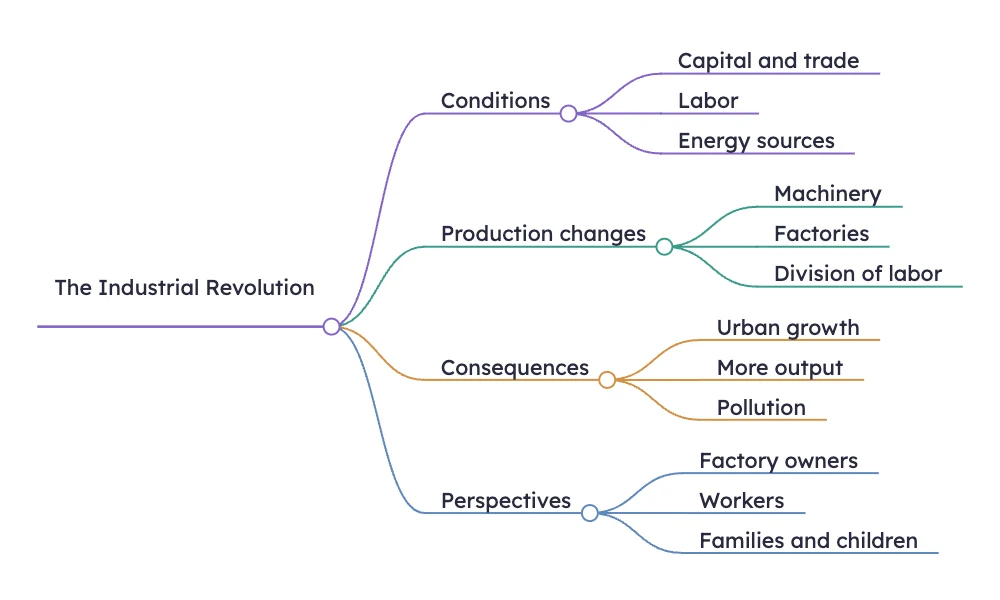
History · Overview
Separate conditions, production changes, and uneven social consequences.
Download original · PDFWorksheet & answers · PDFIndustrialization began in Britain in the eighteenth century and developed differently elsewhere. Machinery, factories, energy sources, capital, and trade interacted. Production increased, but working conditions and environmental damage raised serious problems. Owners, workers, and families did not experience the changes in the same way.
Distinguish contributing conditions from changes and consequences. Use perspectives to compare experiences.
Compare textile production in a workshop and a factory. Explain one productive advantage and one social cost using historical evidence.
One invention cannot explain the entire transformation. Examine its economic and social context.
Benefits and costs were uneven
A change could benefit one group while imposing costs on another.
Urban growth
Industrial employment contributed to changes in settlement and migration.
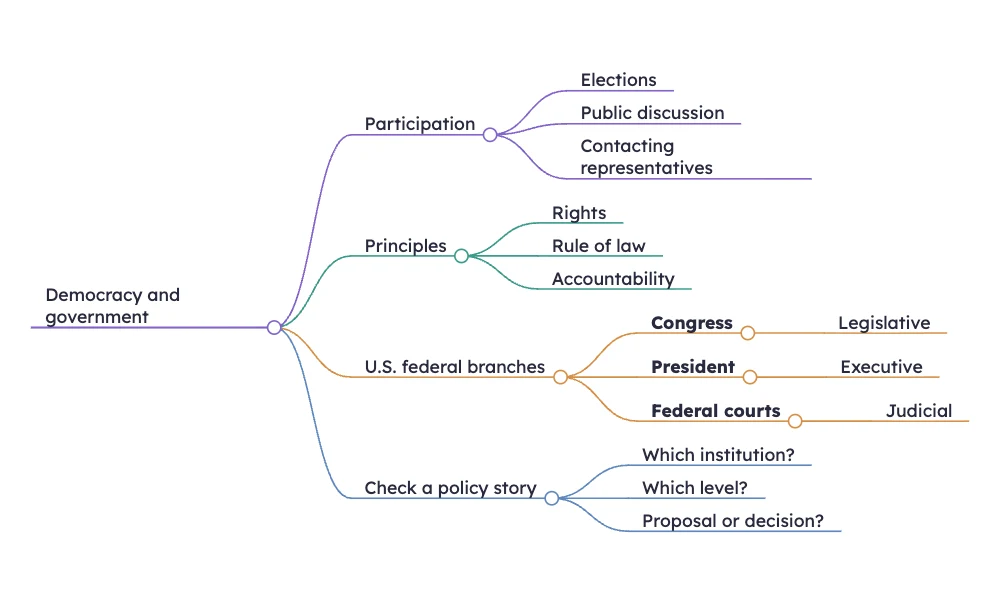
Civics · Foundation
Use a clearly labeled U.S. example to distinguish participation, rights, and institutional responsibilities.
Download original · PDFWorksheet & answers · PDFDemocracy involves representation, accountability, rights, and participation between elections. In the U.S. federal government, Congress is the legislative branch, the president leads the executive branch, and federal courts form the judicial branch. State and local governments have additional responsibilities. Identifying the relevant level helps make sense of a policy story.
Separate citizens' participation from institutional roles. The government branch is a U.S. example, not a description of every democracy.
Choose a public policy news story. Identify the institution, level of government, and whether the action is a proposal, a decision, or implementation.
Do not confuse federal, state, and local authority or assume that every proposal is already law.
Congress
Congress is the legislative branch of the federal government.
The responsible institution and stage
Authority and decision status help distinguish a proposal from an implemented policy.
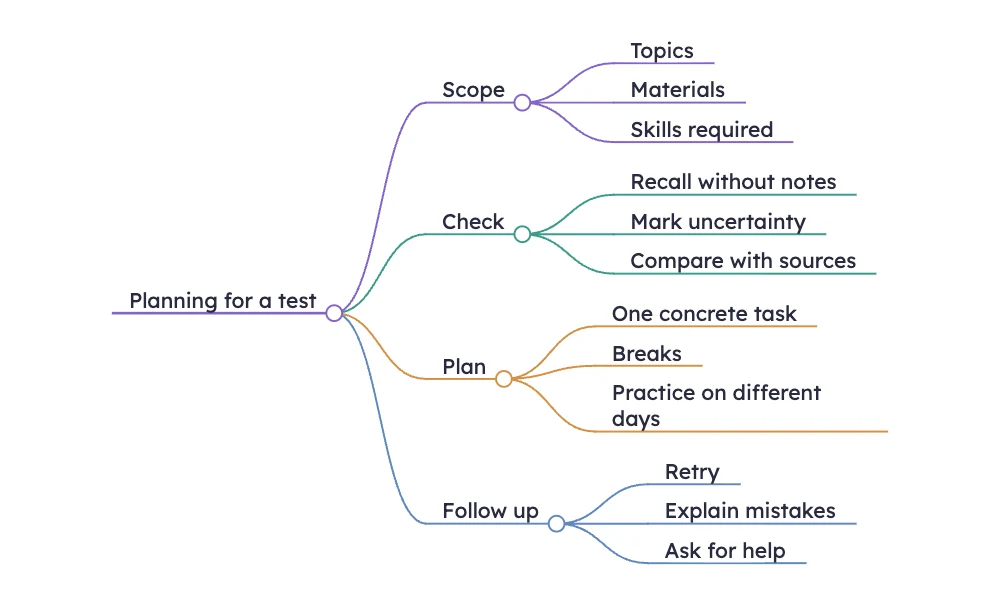
Study skills · Planning template
Turn a broad intention into specific practice and evidence of progress.
Download original · PDFWorksheet & answers · PDFBegin with the topics and skills the test covers. Try a short retrieval task before dividing your time. Use the result to prioritize gaps, spread practice over several days, and leave time to check answers and ask for help. A study session should produce something you can evaluate.
The four branches form a repeatable cycle: scope, check, plan, and follow up.
Choose three test topics. Attempt one question on each without notes, schedule targeted practice, and plan a later retry.
Time spent at a desk is not the same as learning. Look for an explanation or solution you can produce independently.
Solve and check three equations
It names an action and a checkable result.
Choose priorities
It reveals which areas need more work.
Biology · In depth
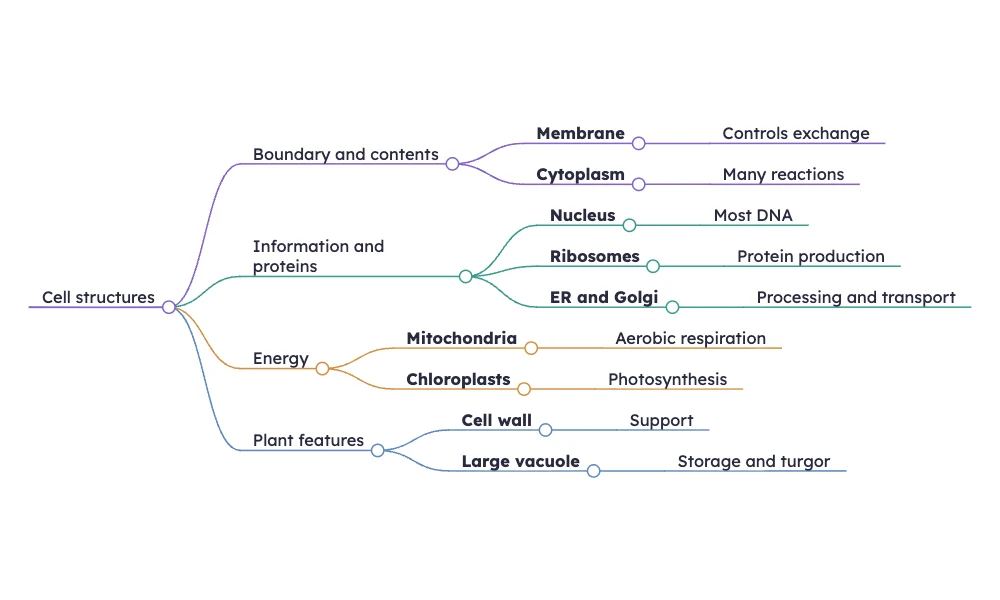
Link organelles to functions and compare animal and plant cells.
Download original · PDFWorksheet & answers · PDFEukaryotic cells contain a membrane, cytoplasm, and specialized structures. The nucleus holds most DNA, ribosomes make proteins, and mitochondria participate in aerobic respiration. Plant cells also have a cell wall; photosynthetic tissues contain chloroplasts. A cell's structures reflect the work it performs.
Group boundaries, information, energy, and plant features. Explain a function for every structure you name.
Compare a leaf cell and a root cell. Explain why both need mitochondria but not every plant cell has chloroplasts.
Not all plant cells photosynthesize. Tissue type matters.
Ribosomes
Ribosomes assemble amino acids into proteins.
No
Chloroplasts are associated with photosynthetic tissues.
Biology · Intermediate
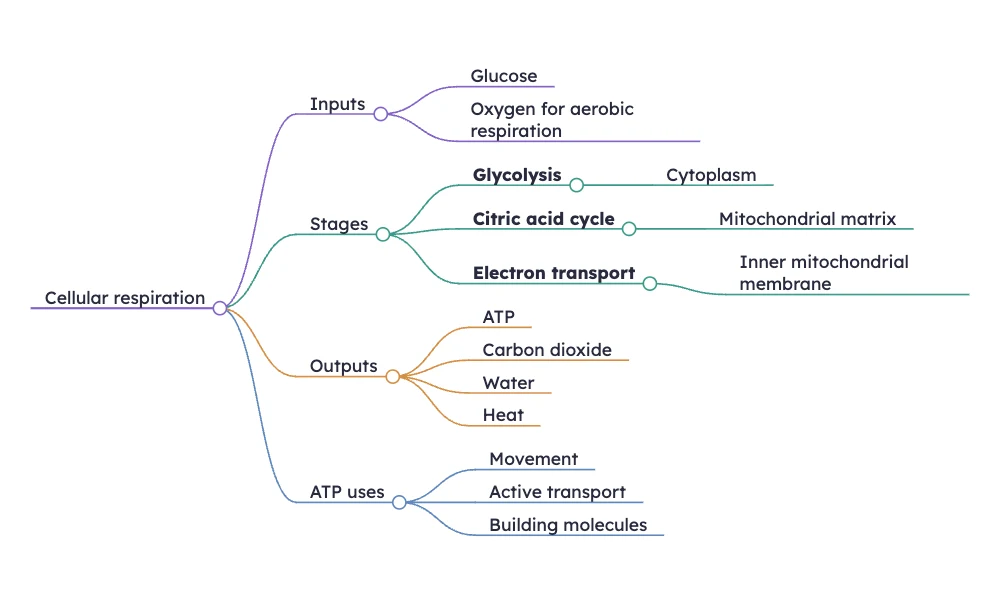
Connect fuel molecules, cellular locations, ATP, and the work cells perform.
Download original · PDFWorksheet & answers · PDFCellular respiration transfers some chemical energy from fuel molecules into ATP. Glycolysis occurs in the cytoplasm. In eukaryotic aerobic respiration, later stages involve mitochondria, and oxygen accepts electrons at the end of the electron transport chain. Carbon dioxide, water, and heat are among the overall outputs.
Separate inputs, stages, outputs, and uses of ATP. Location labels help avoid treating every reaction as mitochondrial.
Explain how energy from a meal can support muscle contraction. Distinguish digestion, transport, and cellular respiration.
Breathing moves air; cellular respiration is a set of chemical reactions. Plants carry it out too.
Cytoplasm
Glycolysis occurs in the cytoplasm.
Couple energy release to cellular work
ATP links energy-releasing reactions to processes that require energy.
Biology · In depth
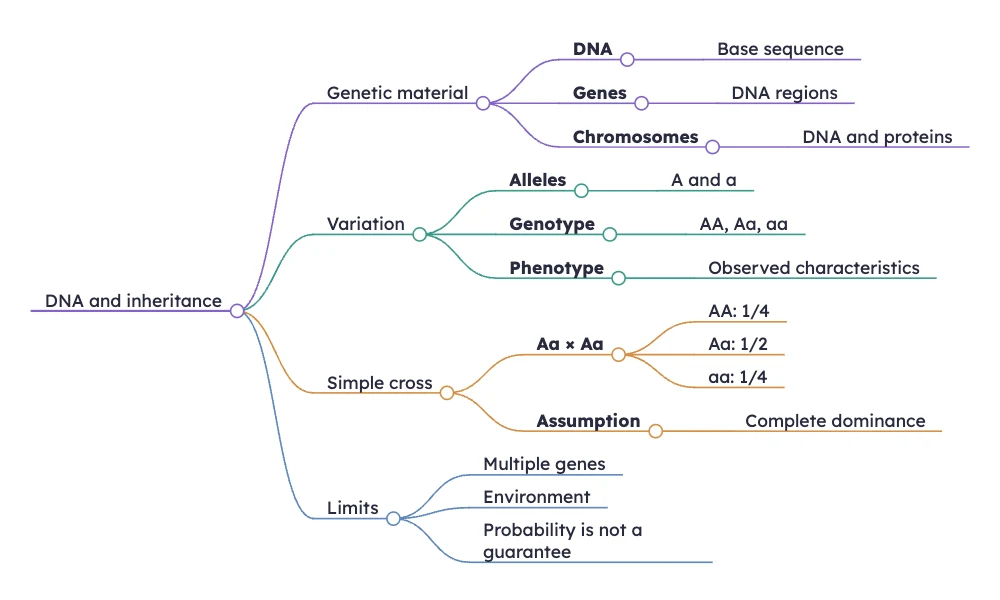
Connect DNA, genes, chromosomes, alleles, and the limits of simple inheritance models.
Download original · PDFWorksheet & answers · PDFDNA stores genetic information. Genes are DNA sequences contributing to functional products, and chromosomes package DNA with proteins. Alleles are variants at a locus. Many traits involve multiple genes and environmental influences. A single-gene cross is a useful model only when its assumptions fit the question.
Move from genetic structures to variation and inheritance. Keep the model's assumptions visible.
For Aa × Aa under complete dominance, list genotype probabilities. Explain why four offspring are not guaranteed to match the ratio exactly.
Dominant does not mean most common, strongest, or best.
1/4
One of the four equally likely allele combinations is aa.
No
Dominance describes an expression pattern, not population frequency.
Biology · Intermediate
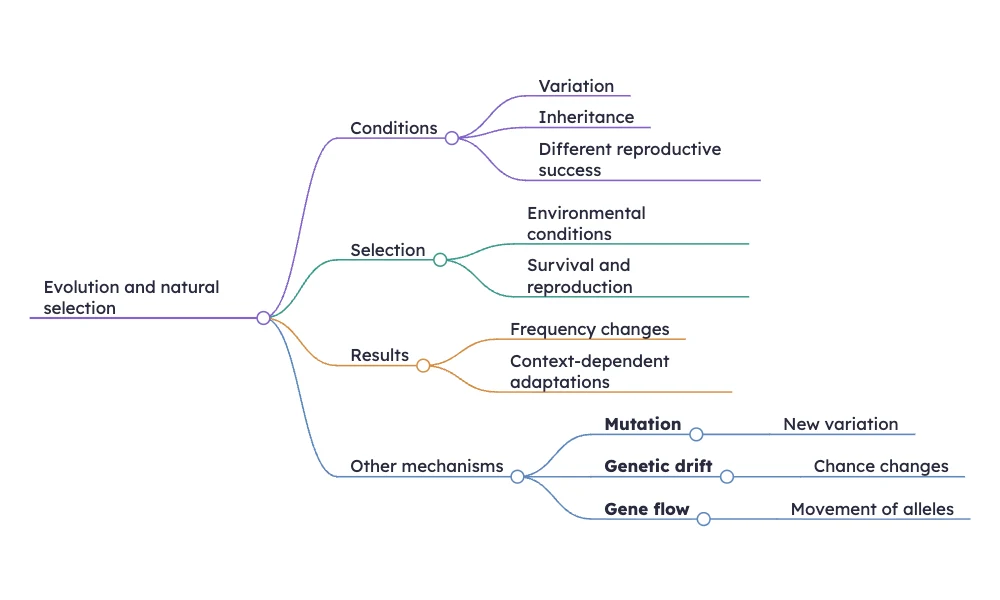
Explain population change through inherited variation and reproductive success.
Download original · PDFWorksheet & answers · PDFIndividuals in a population vary. When heritable differences affect reproductive success in an environment, their frequencies can change over generations. Mutation introduces variation; natural selection does not deliberately create what an organism needs. Genetic drift and gene flow can also change populations.
Separate the conditions for selection, the process, the result, and other mechanisms.
Use insects of different colors on tree bark. Explain how predation could affect the next generation, stating that color must be heritable.
An individual does not evolve by trying harder. Evolution concerns inherited population change across generations.
Populations across generations
Evolution concerns inherited changes in populations over generations.
No
Selection results from differences in reproductive success, not foresight.
Biology · Foundation
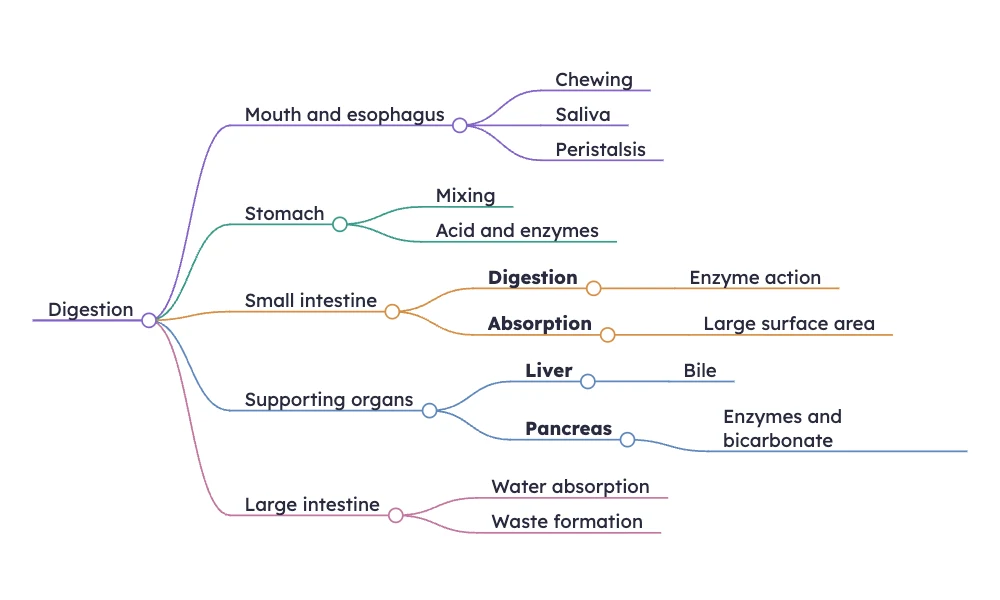
Follow food through breakdown and absorption while distinguishing supporting organs.
Download original · PDFWorksheet & answers · PDFMechanical digestion breaks up and mixes food; chemical digestion uses enzymes to break down molecules. Most nutrient absorption occurs in the small intestine. The liver produces bile, and the pancreas supplies digestive enzymes. The large intestine absorbs remaining water and electrolytes before waste is eliminated.
Follow the digestive tract, with supporting organs on a separate branch. Pair each organ with an action.
Choose a meal containing starch, protein, and fat. Trace one nutrient through breakdown and absorption without confusing those processes.
Bile helps emulsify fat but is not an enzyme. Absorption is different from digestion.
Small intestine
The small intestine has a large surface adapted for absorption.
Emulsifying fats
Emulsification creates smaller fat droplets, helping digestive enzymes act.
Physics · In depth
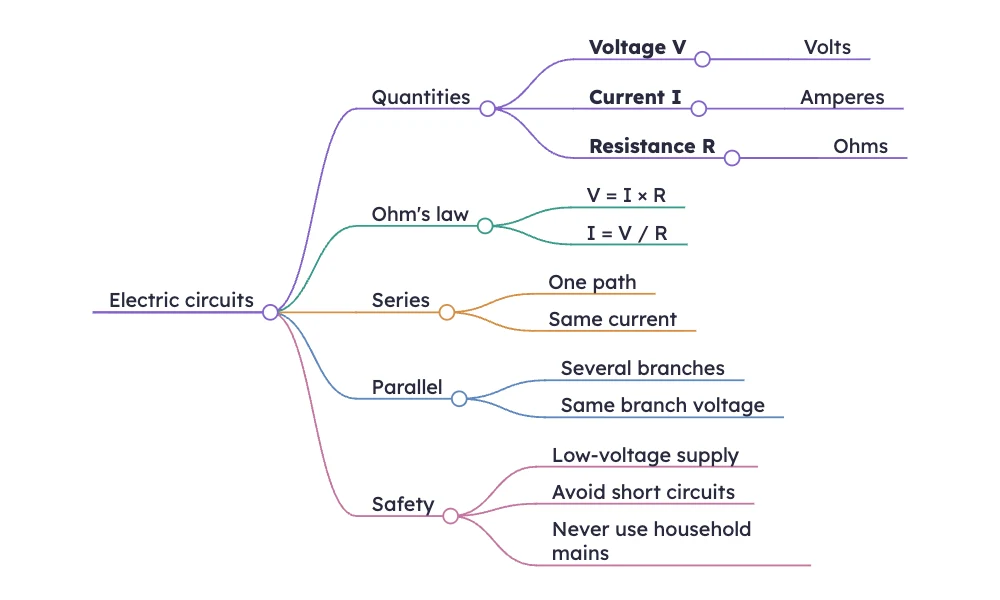
Distinguish current, voltage, resistance, and circuit arrangement.
Download original · PDFWorksheet & answers · PDFCurrent is the rate of charge flow, voltage is potential difference, and resistance relates voltage to current. For an ohmic component under suitable conditions, V = I × R. A series circuit has one current path; a parallel circuit has branches. Practical work should use suitable low-voltage equipment and supervision.
Pair quantities with units before using the equation. Compare the paths in series and parallel circuits.
Calculate the current through a 6 Ω resistor at 3 V. Sketch two lamps in series and parallel using low-voltage classroom equipment only.
Current is not used up by a lamp. In a steady series circuit, it is the same at each point.
0.5 A
I = V/R = 3/6 = 0.5 A.
The same throughout
Charge does not accumulate at each component in the steady circuit.
Physics · Intermediate
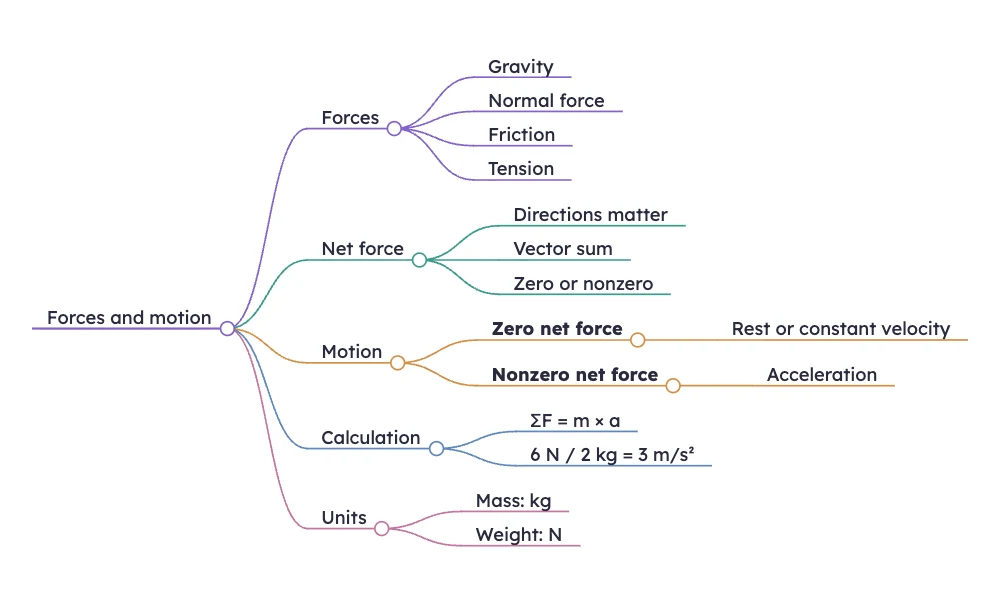
Use net force to explain changes in velocity.
Download original · PDFWorksheet & answers · PDFForces are interactions that can change motion. For constant mass, Newton's second law relates net force to acceleration: ΣF = m × a. Zero net force permits rest or constant velocity. Mass measures inertia, while weight is a gravitational force; they use different units.
Name individual forces, combine them with directions, and then predict acceleration.
Draw the forces on a book resting on a table. Next calculate the acceleration of a 2 kg object under a 6 N net force.
A moving object does not always require a net force in its direction of motion. Net force changes velocity.
3 m/s²
Divide net force by mass: 6/2 = 3 m/s².
No
The object may also move at constant velocity.
Astronomy · Overview
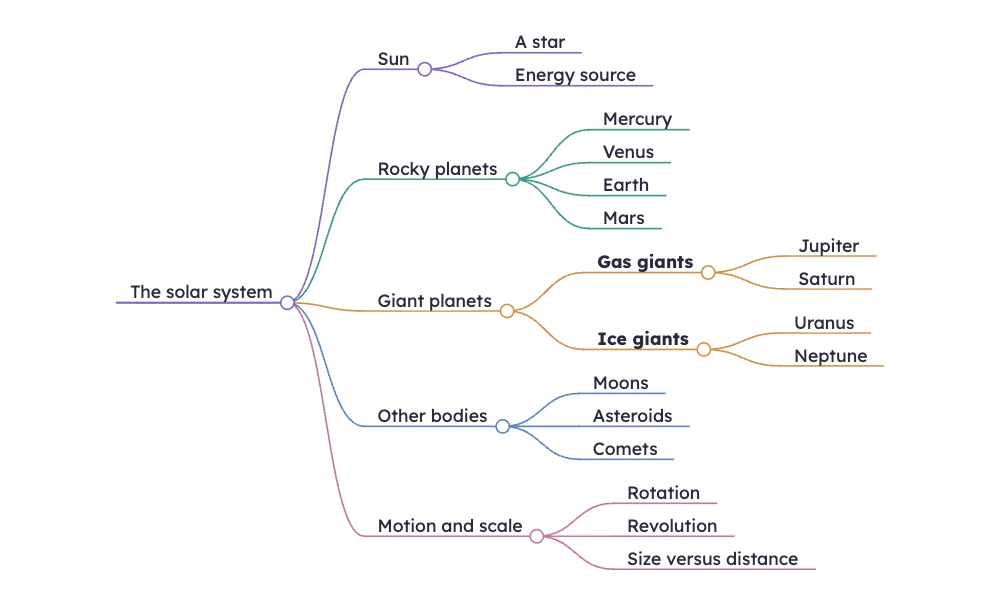
Distinguish planets, orbital motion, rotation, and the limitations of diagrams.
Download original · PDFWorksheet & answers · PDFThe Sun is a star, and eight planets orbit it alongside other bodies. Rotation is spinning about an axis; revolution is orbital motion around another body. Diagrams often compress distances and enlarge planets to make them visible. Check the scale before using a picture to compare size or spacing.
Group planets by broad characteristics, then use motion and scale branches to interpret observations.
List the planets in order from the Sun. Explain why a classroom diagram rarely shows both sizes and distances to the same scale.
Earth's seasons are mainly related to axial tilt, not simply its changing distance from the Sun.
Day and night
Different parts of Earth face the Sun as Earth rotates.
Sizes and distances may be simplified
A readable diagram can distort the true relative sizes and distances.
Chemistry · Intermediate
Interpret measurements and indicators without tasting or mixing chemicals.
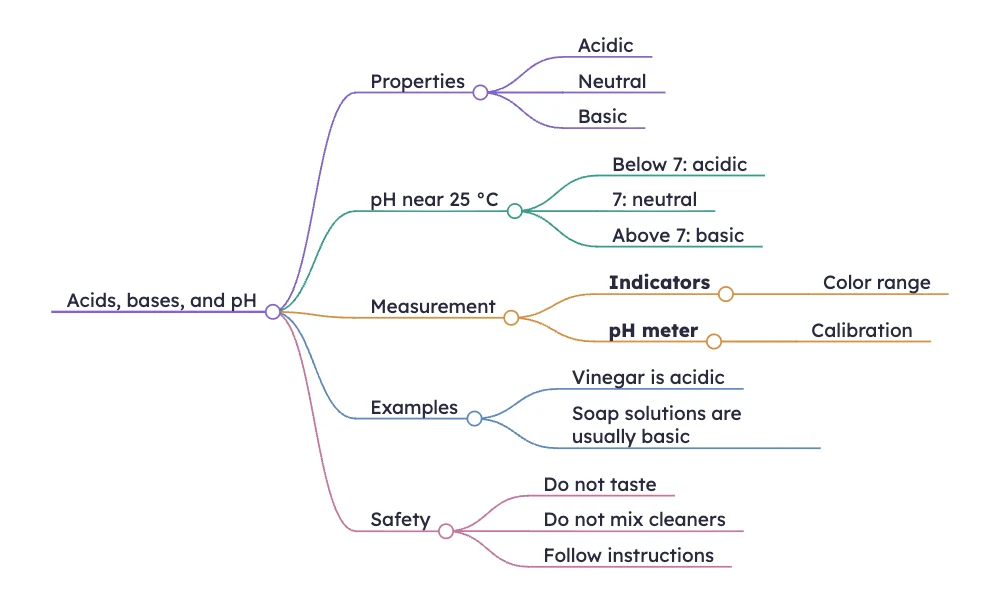
Download original · PDFWorksheet & answers · PDFIn aqueous solutions near 25 °C, pH below 7 is acidic, 7 is neutral, and above 7 is basic. The pH scale is logarithmic. Indicators change color over ranges, so their colors do not always provide exact values. Chemical behavior and risk also depend on the substances and concentrations involved.
Separate properties, measurement, examples, and safety. Treat a color as an observation that needs interpretation.
Use a teacher-provided indicator chart and labeled samples. Record the observed colors before classifying each solution.
Never taste chemicals or mix cleaning products. Natural origin and pH alone do not establish safety.
Acidic
Its pH is below the neutral value at that temperature.
An observation to interpret
Compare the color with the indicator's known response range.
Mathematics · Foundation
Choose the right quantity, formula, and units for a shape.
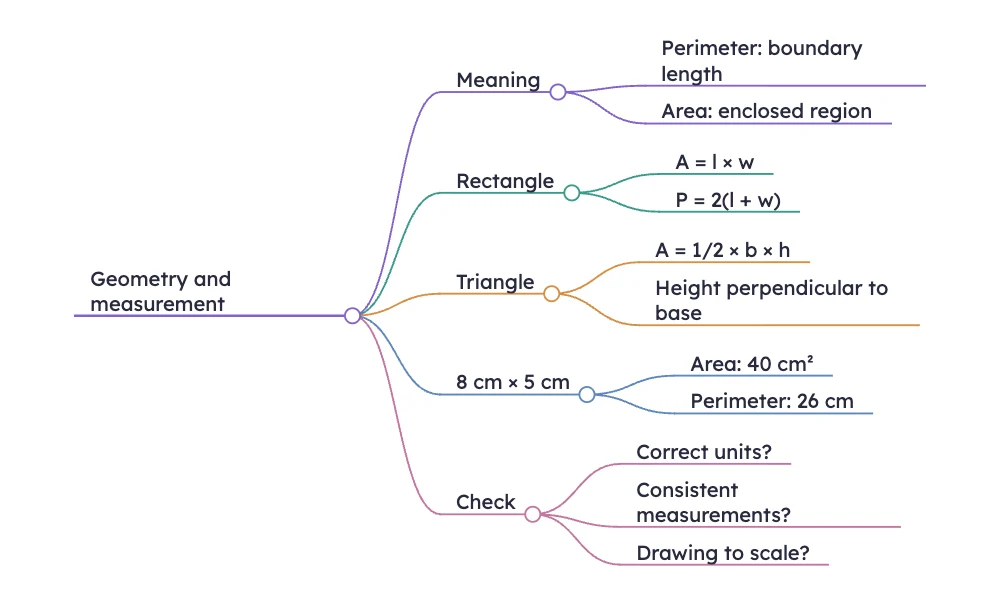
Download original · PDFWorksheet & answers · PDFPerimeter measures a boundary's length; area measures the enclosed region. A rectangle's area is length × width. A triangle's area is half its base × perpendicular height. Area uses square units. A drawing that is not to scale should be interpreted using its stated measurements.
Start with meaning, then formulas, a worked example, and checks.
Find the area and perimeter of an 8 cm by 5 cm rectangle. Draw another rectangle with the same area but a different perimeter.
A triangle's sloping side is not necessarily its perpendicular height.
40 cm²
Multiply 8 cm by 5 cm to get 40 cm².
No
Area and perimeter measure different properties.
Mathematics · Worked example
Keep both sides equivalent and verify the solution in the original equation.
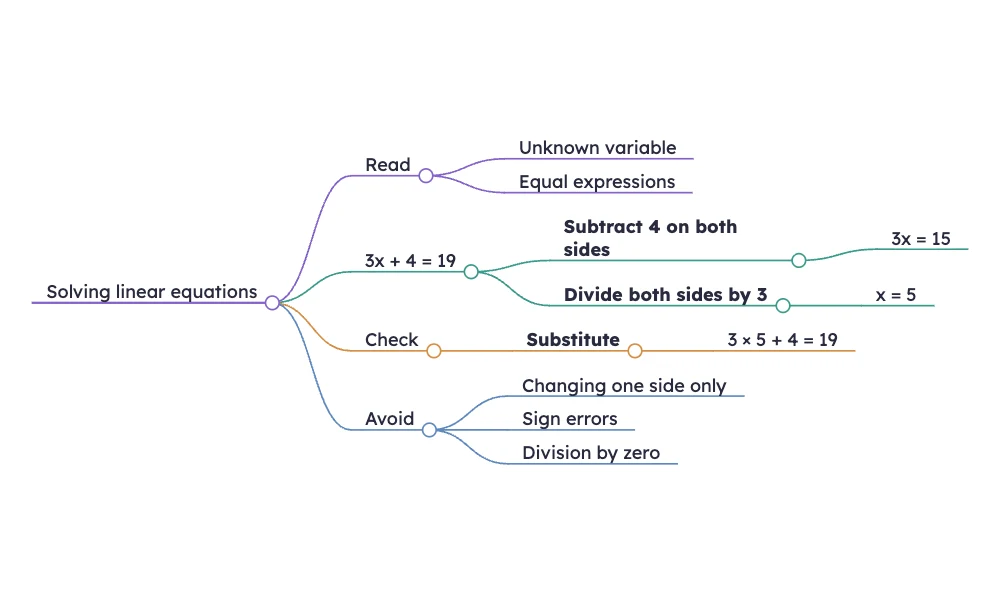
Download original · PDFWorksheet & answers · PDFAn equation states that two expressions have equal value. Apply operations to both sides that preserve equality. For 3x + 4 = 19, subtract 4 from both sides and then divide by 3 to obtain x = 5. Substitution checks that the original equation is satisfied.
Read, transform, solve, and check. Record the operation rather than relying on a mysterious sign-change rule.
Solve 4x − 3 = 17, showing both sides at each step. Write another equation with the same solution and check it.
Changing one side alone generally breaks equality. Never divide by zero.
5
Add 3 to both sides, then divide by 4.
Substitute into the original equation
The two original expressions must have equal value.
Mathematics · Foundation
Define outcomes and assumptions before calculating a chance.
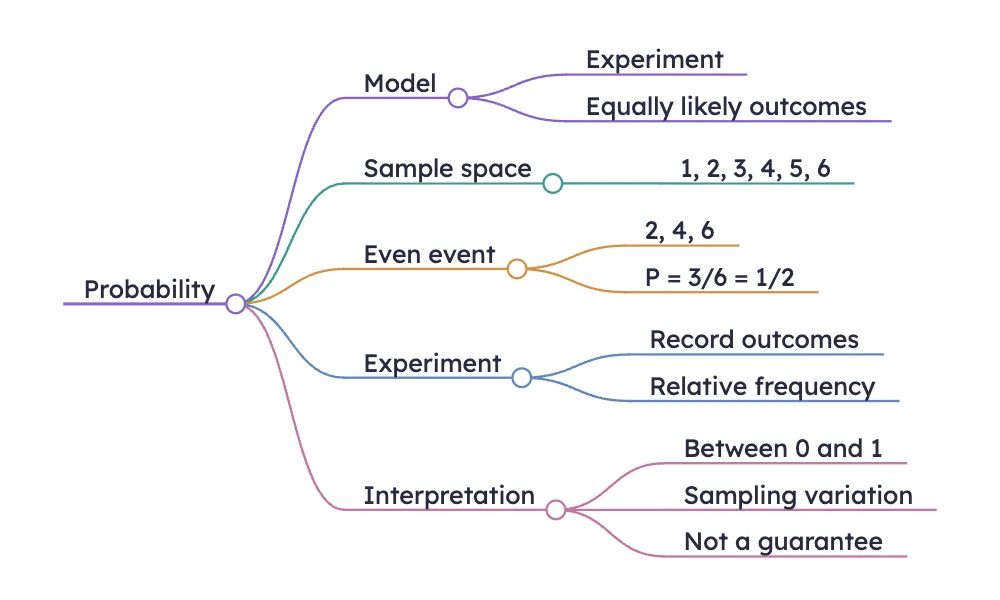
Download original · PDFWorksheet & answers · PDFFor equally likely outcomes, an event's probability is the number of favorable outcomes divided by the total number. Probabilities range from 0 to 1. Experimental relative frequencies can differ from theoretical probabilities, especially in small samples. State assumptions such as a fair die before applying the model.
Separate the model, sample space, event, observations, and interpretation.
Find the probability of an even result on a fair six-sided die. Roll it several times and explain why the observed proportion need not be exactly one half.
A probability of one half does not require alternating results or exact halves in every small sample.
1/2
Three of six equally likely outcomes are even.
No
The model describes chance, not a guaranteed sequence.
Mathematics · In depth
Choose summaries after understanding the question and how the data were collected.
Download original · PDFWorksheet & answers · PDFThe mean is the total divided by the number of values. The median is the middle value after ordering, and the mode is the most frequent value. Extreme observations can strongly affect the mean. Sampling and measurement affect conclusions; graph scales can also shape impressions.
Move from the question and sample to summaries and interpretation. Keep limitations alongside the calculation.
Use travel times of 10, 15, 15, 20, and 60 minutes. Find the mean, median, and mode, then explain which best describes a typical journey in this small group.
Association does not by itself establish causation. Consider other factors and the study design.
15
The third value in the ordered list is 15.
The value 60 raises the total
The high observation influences the mean more strongly than the median.
English · Foundation
Identify nouns, verbs, and adjectives by examining them in a sentence.
Download original · PDFWorksheet & answers · PDFWord classes describe grammatical behavior. Nouns can name things or ideas; verbs express actions or states; adjectives describe properties. English adjectives usually do not change to agree with noun number: a green leaf, green leaves. The same word can belong to different classes in different contexts, so read the whole sentence.
Each branch combines a class, examples, and a test. Distinguish word class from sentence function.
Analyze “The curious student reads a short story.” Identify a noun, verb, and adjective. Then use “book” as a noun and as a verb in different sentences.
A subject is a sentence function, not a word class. Meaning alone is not always enough to classify a word.
curious
Curious describes the student.
A word can serve different grammatical roles
For example, book can name an object or express a booking action.
English · Writing template
Organize accurate information around a question and useful subtopics.
Download original · PDFWorksheet & answers · PDFAn informative text explains a topic for a particular reader. Begin with a focused question, gather suitable sources, and group information into paragraphs with clear purposes. Explain unfamiliar terms and connect examples to the main point. Separate established information from uncertainty and identify where claims come from.
The branches move from purpose and sources to structure and checking. Give each paragraph one main job.
Explain how rainwater reaches a river for a younger student. Plan three paragraphs, add one example, and identify a claim that needs a source.
A collection of copied facts is not yet an explanation. Show how the facts answer the reader's question.
The reader's question
Each paragraph should help answer the focused question.
An explanation and example
A concrete example helps connect a definition to use.
Communication · Planning template
Plan a message, supporting points, visuals, and a useful rehearsal.
Download original · PDFWorksheet & answers · PDFA clear presentation fits its audience and available time. Choose a main message, support it with a few relevant points, and make transitions explicit. Slides should help explain rather than reproduce the entire script. Rehearsing aloud reveals unclear explanations and unrealistic timing.
Separate content from delivery and rehearsal. Prepare for questions rather than treating them as an afterthought.
Prepare a three-minute presentation about reducing school waste. Rehearse aloud and ask a listener to summarize the main message.
Reading a dense slide word for word makes listening harder. Use concise cues and meaningful visuals.
Ask a listener to summarize it
The listener's summary reveals what they understood.
Say so and identify how to check
Acknowledging uncertainty protects the accuracy of the presentation.
Media literacy · Activity template
Trace a claim to its evidence, date, purpose, and original context.
Download original · PDFWorksheet & answers · PDFEvaluate a source in relation to the question you want answered. Identify who produced the claim, when it appeared, and what evidence supports it. Several websites may repeat one original source rather than provide independent confirmation. An authentic image can mislead if its date or location is misrepresented.
Separate origin, evidence, context, comparison, and the decision to share. Uncertainty is a valid outcome.
Choose a public claim without personal information. Find the original source and date, then record two supported points and one unresolved question.
Popularity is not independent verification. Check whether apparent confirmations all trace back to one unsupported post.
Possibly just one original source
Repeated publication does not make evidence independent.
A false date or location
The accompanying context may be false even when the image is genuine.
History · In depth
Separate long-term conditions, events, political ideas, and contested outcomes.
Download original · PDFWorksheet & answers · PDFThe French Revolution began in 1789 amid financial pressures, social inequalities, and political debate. Institutions and alliances changed through successive phases. Rights and citizenship became central issues, but their application was limited and contested. A timeline helps prevent events from different phases being compressed into one moment.
Group causes by type, use dates for sequence, and connect ideas to their practical limits.
Build a short timeline of three verified events. Choose one declared right and investigate which groups actually enjoyed it at a particular stage.
A trigger is not the same as a long-term cause. Revolutionary groups did not all share the same aims.
Institutions and phases changed
Sequence helps distinguish developments in different phases.
Through interacting factors
Economic, social, and political conditions need to be considered together.
Computing · Foundation
Turn a problem into data, decisions, repetition, and tests.
Download original · PDFWorksheet & answers · PDFA program applies instructions to transform inputs into outputs. An algorithm describes the steps; code expresses them in a programming language. Variables hold values, conditions select actions, and loops repeat work. Tests should include normal cases, boundaries, and invalid input, with expected results written in advance.
Define the problem before choosing code structures. Keep testing alongside implementation.
Design a checker for scores from 0 to 100. Reject invalid values before applying grade rules, then test 0, a boundary, 100, and 101.
A program can run without errors and still give the wrong answer. Compare behavior with the requirements.
To check invalid-input handling
An out-of-range case checks validation.
A sequence of problem-solving steps
An algorithm describes a process that code can implement.
Collaboration · Project template
Agree on an outcome, responsibilities, checkpoints, and a way to handle setbacks.
Download original · PDFWorksheet & answers · PDFA group project needs a shared outcome and clear completion criteria. Break the work into tasks that produce something concrete, assign responsibility, and identify dependencies. Schedule a review before the final deadline so improvements remain possible. Record decisions and changes where everyone can find them.
The outcome branch sets direction; tasks, people, and timing explain delivery. Risks make contingency planning explicit.
Plan a class poster exhibition. Assign research, drafting, fact-checking, and layout tasks, with a shared review before printing.
“Everyone will do it” is not a clear responsibility. Someone should ensure each task is followed through.
To allow review and revision
A checkpoint leaves time to improve before final delivery.
The task is followed through
Clear responsibility is compatible with collaboration.
Start with a topic, add branches, and fill in the details. You don't need to write code. The map grows as you work.
Build your own map. Your draft is saved in this browser when local storage is available. Download the outline as Markdown or the map as SVG.
Explore AI mind mapsBiology is broad; asking what a plant needs for photosynthesis gives your map a useful boundary. Put the topic in the center and choose a lesson, chapter, or task as your source. Separate two questions if they need different structures.
In history, try causes, events, and consequences. In math, try meaning, methods, and checks. Read the branch names together. If you repeatedly hesitate over where an idea belongs, clarify the labels or combine overlapping branches.
Chlorophyll absorbs light preserves a relationship that chlorophyll alone may not remind you of later. Keep labels brief without removing essential meaning. Add a concrete example at the end of a branch to test whether you understand the idea.
Compare your map with the textbook, lesson material, or sources beneath the example. Explain each branch aloud, move misplaced details, and mark unanswered questions. Color can group ideas, but a clear heading must explain what the group means.
Cover the details and reconstruct a branch without looking. Explain a connection or solve a new problem. Check your answer, correct errors, and revisit difficult parts on another day. The worksheet and separate answer key help you practice before checking.
Let AI create from your materialExplore concept mapsOrganize your notes and questionsUse your own course material to create a Study Set. Keep explanations and practice around one topic and use the map to identify what needs more work.
Explore Study SetsMake a question for each important term. Answer before turning the card and add an example in your own words.
Explore flashcardsMove from reading a map to applying the knowledge. When an answer is wrong, find the branch that helps explain the solution.
Explore quizzesUse Cornell notes for fuller explanations, then select the key ideas for a mind map.
Open the Cornell templateStudera.ai is free to try with a daily usage limit. For customers in the United States, Premium costs $5.00 per month when billed monthly or $45.00 per year when billed annually. Prices vary by country; check the pricing page for your currency, limits, and other plans. This mind map library and its manual builder are free without an account.
Yes. Choose Build your own, enter a topic, and add branches and sub-branches with the buttons. Select a branch to edit its text. Your draft is saved in this browser when local storage is available. Download the map as SVG or the outline as Markdown. Use Studera's app for AI generation from your own material.
You can read, open, edit, and download the maps in this library without an account. Other Studera study tools have their own account requirements and usage limits, explained on their pages.
Each map has two landscape A4 PDFs. The original includes the map, explanations, practice questions, and sources. The worksheet has blank branches and an answer key on a separate page. Larger maps also include reading pages with the branches in clear text.
Yes. Open a map, select the material and outline tab, and edit its headings or bullet points. Return to the map to see the result. Download the outline or export SVG to keep your changes. Edits to an example are not automatically saved when you switch examples or leave. The manual builder saves its own draft in this browser.
The PDF buttons download the original prepared print files. To save your own changes, download the outline as Markdown or export the interactive map as SVG.
Yes. Studera's own maps and worksheets in this library may be used and printed for personal study and teaching. Keep Studera.ai and the source references on the material. Linked external sources have their own terms.
Open the PDF, choose landscape A4, and fit it to the printable area. Use the original to read or the worksheet to write your answers. Select only the worksheet page if you do not want to print the answer key.